
How to Check AI Writing Before Buying a Subscription
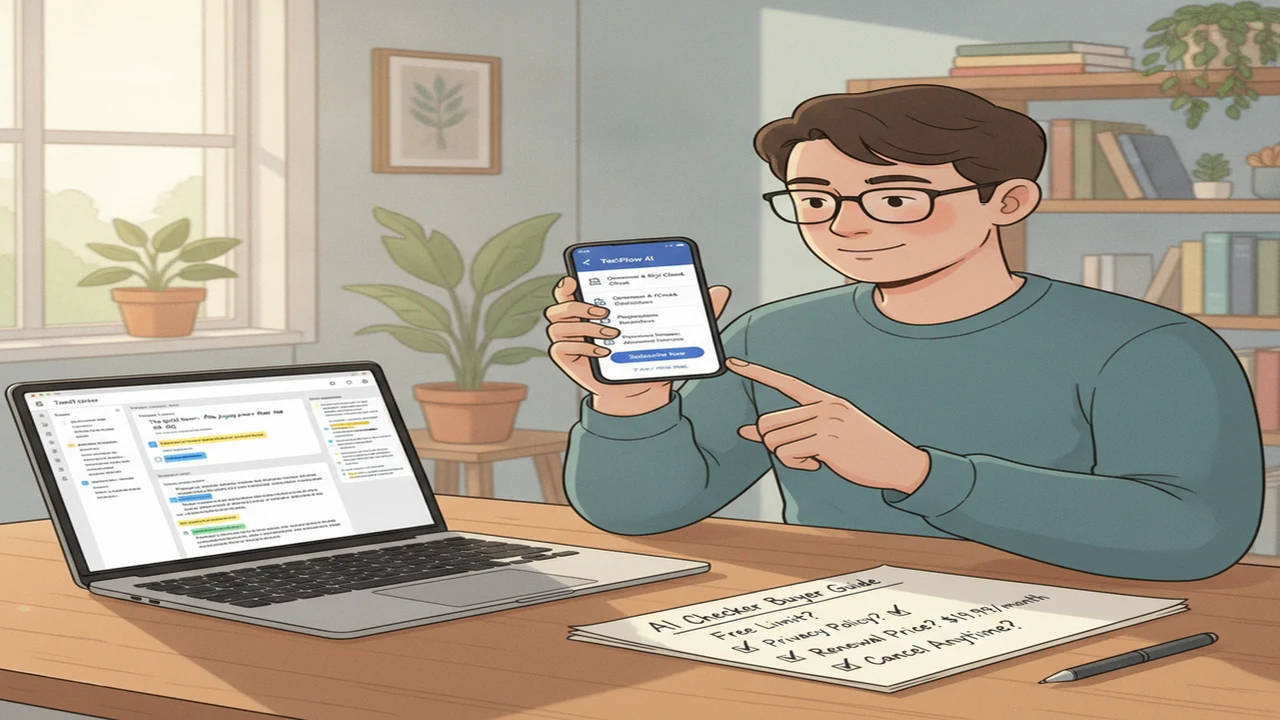
AI writing subscriptions often sell reassurance: paste in a document, receive a percentage, and pay for more scans or a rewrite. The problem is that the percentage can look more certain than it really is. A checker estimates patterns in the text. It does not know who wrote the document or how it was edited.
The safest buying process is to use your own non-sensitive samples, document what each service reports, and inspect the renewal and privacy terms before starting a trial. Turnitin reported that its detector analyzed more than 200 million student papers within its first year of launch, showing how common these checks had become in education (Turnitin, 2023). An Upwork survey about AI-content review found that 49% of businesses using generative AI for content creation also used some form of detection or review process (Upwork, 2023).
Quick answer: Run the same representative samples through a free checker, inspect sentence-level explanations, and read the subscription terms before paying. An AI score is a warning signal, not evidence of authorship. Check input limits, renewal pricing, cancellation steps, privacy language, and whether rewriting preserves meaning. Skip services that hide important limits until checkout or promise certainty.
What does this mean?
Definition: An AI writing checker estimates whether text resembles machine-generated writing, usually by analyzing language patterns. Its score is not definitive evidence that a person or chatbot wrote the text, while a humanizer rewrites passages to make their wording appear less machine-like.
What should you prepare before checking AI writing?
Choose at least three representative samples rather than one polished paragraph. A useful set might include a short email, a longer article or assignment, and a mixed draft that has been edited by a person. Samples should resemble the material you expect to check after subscribing.
Save untouched originals in a folder or document binder before submitting anything. Add a simple note identifying whether each sample was human-written, generated with AI Chat, produced by an AI Writer, or assembled from both. This gives you a known reference instead of judging a checker only by whether its answer feels reassuring.
Remove names, account numbers, client details, unpublished research, medical information, and confidential school or workplace material. Decide whether your actual goal is detection, editing, or rewriting. Those are separate jobs, and paying for all three can be wasteful if you only need an occasional second opinion.
- Choose representative writing samples
- Save untouched originals
- Remove confidential details
How can you check a sample without paying first?
Start with a free check using the AI detection tool. Paste a short sample first, run the check, and record the overall result along with any highlighted sentences. Repeat the process with a longer sample so you can see whether the free input allowance covers the documents you normally handle.
Do not judge the AI Detector App from one passage. Use the same saved samples each time, including at least one document whose origin you know. If the service provides sentence-level markings, note whether they point to specific patterns or merely restate the overall score.
Compare the number of words you can check for free with your likely monthly volume. A free tier that handles one short paragraph may be useful for occasional emails but poor value for an editor processing several long documents. Look for visible limits before creating an account or entering payment details.
- Run the free check
- Record scores and highlighted passages
What does an AI detection score actually tell you?
A detection percentage is an estimate of how strongly a passage resembles patterns associated with generated writing. It is not a probability that a named person used AI, and it does not establish the document's history.
False positives are possible. Formulaic reports, simple explanations, translated passages, and writing with repeated sentence structures may look machine-like even when a person wrote them. A mixed draft can also receive a single score that hides the difference between generated sections and extensive human editing.
Read explanations and highlighted passages before reacting to the percentage. Check for repetitive structure, unsupported claims, fabricated citations, abrupt voice changes, and shallow context. Guidance on identifying AI writing commonly recommends combining software signals with human review rather than relying on a detector alone.
If a second service such as GPTZero returns a different result, document the disagreement. Conflicting scores are a reason to investigate context, not a reason to keep purchasing scans until one tool produces the answer you want.
- Review explanations instead of relying on percentages
Which subscription details should you inspect before checkout?
Read the checkout screen, store listing, pricing page, and cancellation instructions together. A low monthly equivalent on an annual plan can still require a large payment upfront. A free trial may also convert automatically unless it is cancelled before the stated billing date.
Calculate the price for the volume you actually need. Check whether usage is counted by words, documents, scans, credits, or team seats. Find out whether unused credits expire and whether detection, plagiarism review, file uploads, and rewriting sit behind different plans.
Look for the renewal price, billing interval, trial conversion date, refund wording, family-sharing eligibility, and the route used to cancel. Set a calendar reminder as soon as a trial starts. For more context, our guide to how to review an app subscription before paying examines whether a paid detector offers enough extra value over a free option.
A service that reveals its meaningful limits only after payment is easy to skip. The same applies when cancellation instructions are vague, the advertised price applies only to a long commitment, or the plan renews at a higher rate that is difficult to find.
- Calculate the full renewal cost
- Cancel any trial reminder before the billing date
Which permissions and privacy terms deserve attention?
Anything pasted into an online checker leaves your device for processing unless the documentation explicitly describes an on-device system. Read what the service says about text retention, third-party processors, analytics, model training, account deletion, and the removal of submitted documents.
On a phone, inspect requests for clipboard access, tracking, contacts, photos, and notifications. Clipboard access may be useful for pasting text, but broad tracking is not necessary to calculate a writing score. An account requirement also matters because it connects scans and stored history to an identity.
School assignments, client drafts, employment records, medical notes, legal documents, and personal messages deserve extra caution. If retention or training language is unclear, use a redacted excerpt or do not submit the material. Our overview of what app privacy labels can tell you explains how to compare disclosed collection practices across checker apps.
Do not assume deletion happens when an app is removed from a phone. Look for a document-delete control, an account-deletion route, and a stated retention period. If those details cannot be found, contact the provider before uploading sensitive material.
- Inspect permissions and retention terms
Should you pay for detection, humanizing, or both?
Detection and rewriting solve different problems. A detector identifies passages that resemble generated text. A humanizer changes wording, rhythm, or sentence structure. Combining them may be convenient, but convenience is only useful if the rewrite preserves facts, citations, tone, and the writer's intended meaning.
The AI humanizer for iPhone is an example of an iOS product presenting checking and humanizing functions together. Before subscribing, inspect the listed in-app purchases and confirm whether both functions are included in the same tier, whether each action consumes credits, and whether the displayed price uses weekly, monthly, or annual billing.
Run a rewritten passage against the untouched original. Check every number, quotation, source, product name, instruction, and qualification. ACI or any similar rewriting service can produce cleaner-looking prose while still changing a detail that matters.
Do not pay for a humanizing feature merely to chase a lower detection score. For school or work, rewriting generated text may also conflict with applicable submission rules. Editing for clarity and accuracy is a more defensible goal than attempting to conceal authorship.
- Choose only the feature set needed
How should you compare results before choosing a plan?
Create a small comparison sheet and run the same known samples through every candidate. Record the overall result, highlighted passages, explanation quality, input limit, processing options, privacy terms, and full monthly cost. Keep screenshots or exported reports if the service permits it.
Run each sample more than once only when the product documentation suggests that results may change. Stability matters, but so does usefulness. A consistent score without any explanation may be less valuable than a cautious result that points to the exact sentences requiring review.
Include the AI Detector App in the sheet if its free allowance fits your material, then compare it with unlinked alternatives you may encounter, such as GPTZero or Originality.ai. Do not assume that a higher price produces a more reliable answer. Our guide to GPTZero alternatives and their price and privacy limits provides a broader shortlist.
Use the table below to separate purchase details from marketing claims. Your winning option should fit the real document volume, provide understandable feedback, and disclose enough about billing and data handling for you to make an informed choice.
- Record scores and highlighted passages
- Review explanations instead of relying on percentages
What are the limits of AI writing checks?
AI detection scores are estimates and cannot establish who wrote a passage. Different checkers can return conflicting results for identical text, while short, heavily edited, translated, or formulaic writing can be particularly difficult to classify.
A humanizer can alter meaning, citations, tone, or factual details. Product behavior, prices, free limits, and privacy terms may also change after this article's review date. Public listings can omit operational details, so missing information does not establish that a feature or practice is absent.
Use a score as one input alongside document history, version records, citations, writing context, and a conversation with the author. It should not be the sole basis for an accusation, academic penalty, employment decision, or purchase.
- AI scores do not establish authorship.
- Different services can disagree about the same passage.
- Short and extensively edited text may be harder to classify.
- Rewriting can change facts, citations, or voice.
- Pricing, limits, and privacy terms can change.
When is an AI writing subscription worth it?
Occasional users should normally stay with a free tier. If you check only a few emails or short drafts each month, a recurring charge is hard to justify unless the free allowance is too restrictive or the paid plan adds a specific control you need.
Students and teachers should place explanation quality and false-positive caution ahead of a more dramatic percentage. Editors and freelancers may benefit from longer inputs, file uploads, history, and exportable reports. Teams should also examine seat pricing, administrator controls, retention settings, and the cost of the expected monthly word volume.
A subscription becomes reasonable when repeated use saves time, the feedback helps you edit, privacy terms fit your material, and the complete renewal price fits the budget. The decision framework in when a paid app is worth the upgrade can help if the main uncertainty is whether paid detection offers a meaningful advantage.
Skip the plan if you are buying only for a reassuring score, an automatic promise to humanize AI writing, or an annual discount you may not use. Monthly billing can cost more per month, but it may be safer while you establish your real workload.
- Choose only the feature set needed
Comparison
| Check before paying | Why it matters | Good sign | Reason to skip |
|---|---|---|---|
| Free-tier input limit | Shows whether typical documents fit before payment | Word or document caps are displayed clearly | Limits appear only after signup |
| Score explanation | Helps you understand why text was flagged | Sentence-level notes or highlighted passages | Only an unexplained percentage |
| Rewrite controls | Reduces unwanted changes to meaning and voice | Tone, length, and passage controls with previews | Automatic rewriting with no comparison view |
| Text retention | Affects confidential and unpublished material | A stated retention period and deletion control | Vague storage or training language |
| Account and tracking permissions | Determines how scans may be tied to an identity | Only permissions needed for the feature | Broad tracking or unrelated access requests |
| Monthly and annual renewal price | Reveals the real recurring cost | Full amount and billing interval shown before purchase | Only a discounted monthly equivalent is prominent |
| Cancellation process | Prevents unwanted trial conversion or renewal | Clear in-app or account cancellation route | Instructions are hard to locate |
| Refund terms | Shows what happens after an accidental charge | Plain eligibility and request instructions | No visible policy before checkout |
| Export or history access | Matters when reviewing many documents | Downloadable reports or manageable scan history | Results disappear with no record or deletion control |
Limitations
Frequently Asked Questions
Can an AI checker prove that a person used AI?
No. It estimates whether language resembles patterns associated with generated text. Authorship decisions require supporting context such as drafts, version history, citations, and a fair conversation with the writer.
How many writing samples should I check before subscribing?
Use at least three representative samples: one short passage, one longer document, and one mixed or heavily edited draft. Include material with a known origin so you can evaluate the usefulness of the explanations rather than guessing from the score.
Is the AI Detector free to try?
The public product site offers a route to check text, but confirm the current free word limit, account requirement, and paid-plan terms on the day you use it. Listings and allowances can change.
What should I verify in the ACI App Store subscription listing?
Check the displayed in-app purchases, billing interval, trial conversion date, renewal price, cancellation route, privacy label, and whether both checking and rewriting are included in the chosen tier.
Can an AI Humanizer change the meaning of my writing?
Yes. Rewriting can alter qualifications, numbers, citations, names, tone, or factual details. Compare the result with the untouched original and verify every important claim before using it.
Is it safe to paste school or work documents into an AI checker?
It depends on the document and the service's retention and processing terms. Remove confidential details, check applicable school or workplace rules, and avoid uploading sensitive text when storage, training, or deletion practices are unclear.
Why do two AI content detectors give different scores?
Services can use different models, reference data, thresholds, and methods for handling edited or mixed text. A disagreement shows why percentages should be combined with sentence-level review and contextual evidence.
Should I choose a monthly or annual AI writing plan?
Choose monthly billing while learning your actual usage, even if its monthly rate is higher. An annual plan makes sense only when the full upfront cost is clear, the service has become part of a recurring workflow, and the cancellation and renewal terms are acceptable.