
Are Paid AI Detectors More Accurate Than Free Ones?
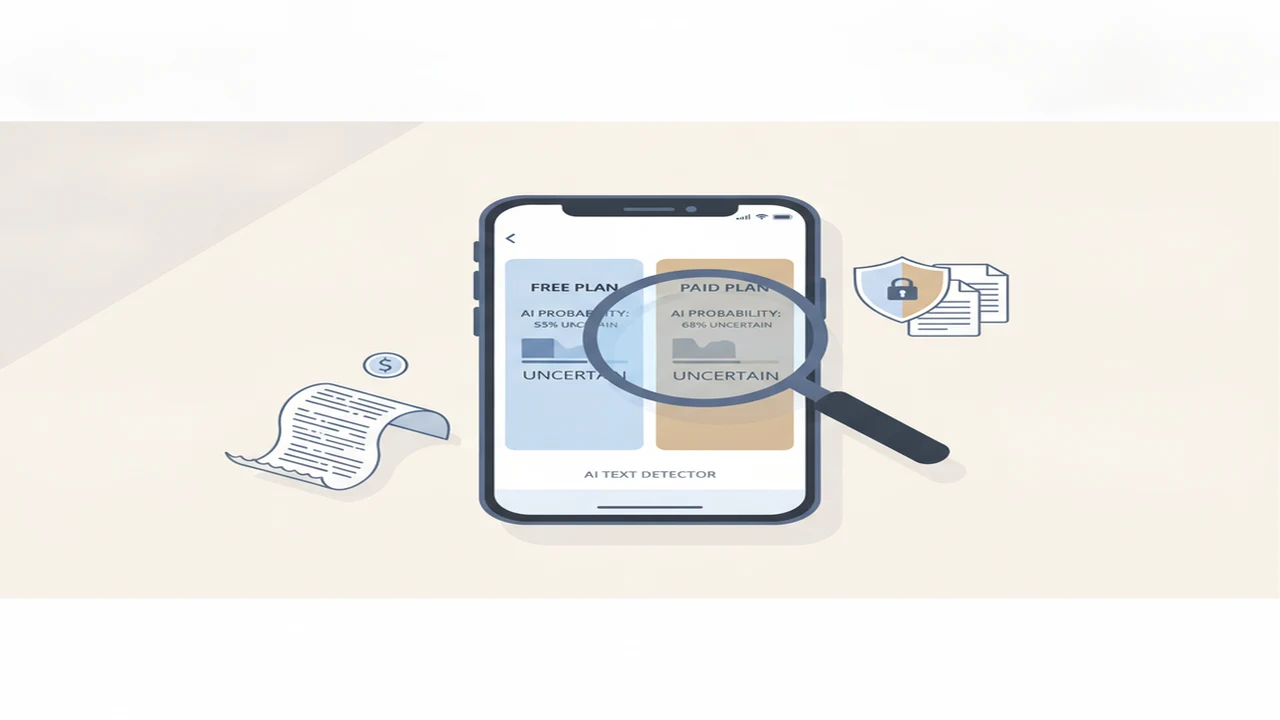
The main difference between a free AI checker and a paid plan is often capacity, not intelligence. The subscription may accept more words, retain previous scans, export reports, or provide team access while using the same basic scoring system available to free users.
That distinction matters because detector scores can look more certain than they are. A polished dashboard and a monthly bill do not establish better accuracy. Buyers need to separate documented workflow benefits from marketing claims, then decide whether those benefits justify the recurring cost.
Quick answer: Paying does not automatically make an AI detector more accurate. A subscription commonly buys longer document checks, higher monthly limits, reports, history, or rewriting tools. Accuracy still varies with the detector, language, sample length, editing, and scoring threshold. Use every result as a signal, review flagged passages yourself, and skip subscriptions that present a probability score as certain proof.
What does this mean?
Definition: An AI detector estimates whether patterns in a piece of text resemble machine-generated or human writing; it does not prove who wrote the text or which tool was used.
Does paying for an AI detector make it more accurate?
Not by itself. Some vendors may reserve a newer model or more detailed analysis for paid customers, but others mainly charge for higher limits and convenience. Unless the vendor documents separate models or publishes comparable evaluation details, price alone says little about paid vs free AI detector accuracy.
Two errors matter. A false positive labels human writing as AI-like, while a false negative misses machine-generated text. A useful comparison should report both rather than promoting one headline accuracy percentage.
Published results also depend heavily on the material being checked. A Digital Applied benchmark reported in 2026 found that no detector exceeded 85% across the models in its test set. Its best GPT-5.4 result was 84%, with a 5% false-positive rate. Those figures describe that benchmark, not a permanent ranking for every language or writing style.
What should you check before paying for an AI detector?
Start with what the vendor documents. The public make AI text sound human product page is one listing readers can inspect for current features, plan information, and access terms. Do not infer a capability merely because a page uses broad phrases such as advanced detection.
Look for model coverage, supported languages, minimum useful sample length, file formats, and an explanation of score labels. Check whether the paid plan changes the detection method or simply increases the number of words you can submit.
The free tier should give you enough access to judge the interface and score presentation. Our guide to checking AI writing before buying a subscription provides a focused trial workflow without repeating every buying issue here.
- Is the detection method or evaluation process described?
- Are language and document-length requirements stated?
- Can reports or scan records be exported?
- Are uploaded documents retained or used to improve a model?
- Can you delete your account and stored text?
- Is renewal pricing visible before starting a trial?
Why can free and paid detectors disagree?
Different tools may evaluate sentence predictability, word choice, variation, structure, or other statistical patterns. They can apply different thresholds even when they analyze similar signals. One AI content detector might label a passage likely AI while another describes the same score as uncertain.
Sample construction changes results too. Short passages provide fewer patterns to assess. Quotations, templates, technical definitions, and formulaic business writing may resemble text in a detector's machine-generated examples. Translated writing and work by non-native English speakers can also be classified unfairly.
Edited AI writing creates another complication. Reordering sentences, adding personal details, or replacing predictable phrases may change a score without changing the underlying authorship history. Conversely, editing concise human prose can make it appear more regular. GPTZero and Copyleaks can therefore disagree without either result establishing who wrote the passage.
Which paid features are actually worth buying?
The strongest reasons to pay are operational. Longer file limits help editors handling reports, while batch processing may save time for teams reviewing many documents. Downloadable reports, scan history, shared workspaces, plagiarism checks, and API access can also solve recurring workflow problems.
An AI Checker bundle may include rewriting or humanizer functions. AI Detector App, for example, should be evaluated according to the features and terms currently documented on its site rather than an assumption that bundling detection with an AI Humanizer improves either function.
Rewriting tools deserve separate scrutiny. A button promising to humanize AI writing may alter tone or phrasing, but it cannot make a detector score reliable or settle authorship. It may also introduce factual errors, flatten the writer's voice, or create a second copy of sensitive text on another service.
Choose a plan based on monthly scan volume and required exports, not the most expensive tier. For broader options, see our guide to AI checker costs, privacy, and features.
What privacy questions should you ask before uploading text?
An uploaded essay, client draft, employment document, or unpublished article may contain names, confidential facts, or proprietary ideas. Check whether the service stores submitted text, connects it to an account, shares it with service providers, or uses it to improve detection and writing models.
The iPhone AI checker should be read alongside its current privacy disclosures and subscription details. Store privacy labels summarize developer declarations, but they do not replace the full privacy policy or explain every processing decision.
Also consider device permissions. A text checker may need file or photo access if you deliberately import documents or images, but broad access unrelated to the feature deserves scrutiny. If deletion instructions, retention periods, or support contacts are unclear, avoid uploading school, work, legal, medical, or client material.
- What information is collected with the submitted text?
- How long are scans and account records retained?
- Can submissions be used for model improvement?
- Which processors or analytics providers receive data?
- Can individual scans and the entire account be deleted?
- Does cancellation stop billing without deleting stored content?
How should you compare AI detector results responsibly?
Run a small evaluation using writing whose origin you already know. Include several human samples and several unedited outputs from an AI Chat or AI Writer tool. Use sufficiently long passages, preserve the same formatting, and submit unchanged copies to every service.
Record the numerical score, wording of the label, word limit, failed uploads, and any passages highlighted. Do not convert labels such as possibly AI or mixed into a definite accusation. Manually review why a passage may have been flagged, including quotations, repeated structures, and standardized language.
This is a reader workflow, not a Lunchbox Guitars accuracy test. It can reveal whether a service is understandable and useful for your material, but a small personal sample cannot establish a universal accuracy rate.
- Choose known-origin human and AI samples
- Keep sample length and formatting consistent
- Run unchanged text through the free tier first
- Record scores, labels, limits, and processing time
- Review flagged passages instead of accepting the headline score
- Check privacy and deletion terms before uploading sensitive writing
- Compare subscription cost with actual monthly scan volume
- Cancel trials before renewal if the paid workflow adds little value
When should you skip an AI detector subscription?
Stay with a free tier if you only check an occasional paragraph and can work within its limits. A paid plan is also a poor fit when renewal pricing is hidden, cancellation instructions are vague, or the service does not support the language and document type you need.
Skip detection entirely when uploading the text would breach workplace, school, client, or confidentiality rules. Removing names may not be enough if the document contains distinctive events, unpublished research, internal figures, or other identifying details.
Strong certainty claims are another warning sign. A vendor should explain uncertainty rather than suggest its percentage can prove misconduct. If the consequence could affect a grade, job, publication, or reputation, document history, drafts, citations, and a direct conversation are more meaningful than one detector result.
Are paid AI detectors worth it for everyday users?
Occasional users should begin with the free tier and pay only when limits repeatedly interrupt a legitimate workflow. Students generally gain little from scan history or team seats, while editors and teachers may value longer files, organized reports, and repeatable record keeping.
High-volume teams have the clearest case for a subscription, especially when batch checks, exports, account controls, or integrations reduce administrative work. They still need a review policy that prevents one score from deciding the outcome.
For mobile use, ACI may be convenient for users who specifically want detector and rewriting functions in one app, but convenience should be weighed against its current subscription terms and privacy disclosures. Buyers exploring alternatives such as Originality.ai or Winston AI should apply the same standard: pay for documented workflow benefits, not unexplained certainty.
Comparison
| Buying factor | What a free tier may offer | What a paid plan may add | What to verify |
|---|---|---|---|
| Detection model and scoring | Basic score or label | Detailed passage analysis | Whether the underlying model actually differs |
| Text and file limits | Short pasted samples | Long files and batch checks | Minimum length, monthly quota, and file formats |
| Languages and content types | Limited language coverage | Additional languages or document types | Published support for your actual material |
| Reports and scan history | On-screen result | Exports, saved scans, and shared records | Retention period and deletion controls |
| Humanizer or rewriting tools | Limited rewrites | More words or writing modes | Accuracy, privacy, and usage limits as separate issues |
| Privacy and text retention | Account-free scanning in some services | Account-linked history | Storage, model training, sharing, and deletion terms |
| Subscription renewal and cancellation | No recurring payment | Monthly or annual access | Trial length, renewal price, and cancellation route |
| Best fit by usage frequency | Occasional checks | Recurring or team workflows | Whether paid capacity matches actual monthly volume |
Limitations
AI detector scores are estimates, not proof of authorship or misconduct. False positives and false negatives can occur, particularly with short, edited, formulaic, translated, or non-native writing. Detectors may also be unsuitable for poetry, code, transcripts, tables, and other content outside their documented scope.
Models, thresholds, usage limits, and subscription terms can change after the article date. There is no universal benchmark covering every chatbot, language, editing level, and type of human writing, and a higher price or longer feature list does not establish better accuracy.
No detector score should be the sole basis for an academic, employment, publication, or disciplinary decision. Serious reviews should consider drafts, revision history, sources, metadata where appropriate, the writer's normal style, and an opportunity for the person to explain their process.
Frequently Asked Questions
Can any AI detector prove that text was written by AI?
No. A detector estimates whether textual patterns resemble material in its AI-generated examples. It cannot establish who wrote a document, which model may have been used, or whether a person substantially revised the text.
Is a paid AI Checker better for long documents?
It may be more convenient because paid plans often raise word or file limits and add reports. Check whether the service analyzes the entire document, splits it into passages, or merely permits a larger upload. Greater capacity does not automatically mean greater accuracy.
Does an AI Humanizer make detection scores reliable?
No. Rewriting can change a detector score, but that does not validate either the original result or the new one. It can also change meaning, introduce errors, and send the text through an additional data-processing service.
Can AI Detector App identify writing from every chatbot?
Its current product documentation should be checked for stated model, language, and content support. No broad claim about detecting every present and future chatbot should be assumed from a general marketing description.
What should I review in the ACI App Store subscription listing?
Check the current price, billing period, trial terms, in-app purchases, renewal instructions, device compatibility, privacy label, and links to the developer's full policies. App Store details can change by country and over time.
Is it safe to upload school or work documents to an AI content detector?
Only if the service's terms and your school or workplace rules permit it. Remove sensitive material where possible, but avoid uploading confidential documents when retention, sharing, model-training, or deletion practices are unclear.
How many detectors should I use before judging a passage?
There is no number that turns estimates into proof. A second tool may expose disagreement, but several tools can share similar weaknesses. Review the writing, drafts, sources, and revision history rather than taking a majority vote among detector scores.
Can teachers or employers rely on one detector score?
They should not use one score as the sole basis for a serious decision. Detector output can begin a careful review, but the writer should be allowed to provide drafts, explain revisions, and challenge an incorrect classification.