
Best Antique Value Apps in 2026
Quick answer: Curio is the best antique value app for most iPhone users because it combines photo identification, value ranges, visual matches and collection exports. AntiqSnap is the better choice for Android users and has a much larger App Store rating count. WorthPoint suits serious sellers who care more about historical sold prices than quick AI identification.
You are standing at an estate sale with a porcelain bowl in one hand and your phone in the other. The label says $75. What is my antique worth, and is the seller's description even close?
An antique value app can give you a starting point before someone else reaches for the bowl. It cannot inspect hidden repairs, prove authenticity or issue an insurance appraisal. The useful apps identify likely matches, explain their estimates and let you check the evidence without turning a $20 curiosity into a year-long subscription.
Comparison at a glance
| App | Best for | Platforms | Free version | Price | Standout |
|---|---|---|---|---|---|
| Curio | Photo identification and value checks | iPhone and iPad | Free download; free-use limits are not stated | October 2026: purchases from $4.99 to $49.99; billing periods vary | Visual matches plus added maker-mark details |
| AntiqSnap | Android users and quick scans | iPhone, iPad and Android | Free download; scan limit is not stated | October 2026: purchases from $3.99 to $39.99; check the listing | Saved archive with estimated collection value |
| Antique Identifier TIQ | Authenticity clues at a low annual price | iPhone and iPad with iOS 18 or later | Free download; free-scan limit is not stated | October 2026: $4.99 weekly or $19.99 yearly | Maker-mark, construction and reproduction clues |
| WorthPoint | Historical sold-price research | Web, iPhone and Android | Free access limits are unknown | October 2026: about $29 to $30 monthly | Database of past sold listings |
| Antique Identifier Zophi | Older iPhones and general identification | iPhone and iPad with iOS 15 or later | Free download; scan limit is not stated | October 2026: $3.99 to $4.99 weekly or $19.99 to $34.99 yearly | Low iOS requirement |
| Relic | Local reseller catalogs | iPhone and iPad | No free AI identification or valuation | October 2026: $5.99 weekly or $39.99 yearly listed | Locally stored catalog with filters |
| Collectibles.com | Mixed collectible collections | iPhone and iPad | Free download; free-use limits are not stated | October 2026: $8.99 monthly, $39.99 yearly or $99.99 lifetime listed | Community profiles and broad category coverage |
Prices and ratings from the US App Store and Google Play, checked October 2026. Store prices change; the listing is the final word.
How we picked
We read the US App Store listings, listed in-app purchases, official sites and available Google Play information in October 2026. We compared identification depth, valuation evidence, collection tools, platform support, subscription cost and update dates. This is a document-based comparison; we did not claim hands-on testing.
The order reflects fit for someone seeking the best antique value app. Rating counts show audience size, not valuation quality. Curio ranks above AntiqSnap despite having fewer App Store ratings because its visual matches and added mark details give you more ways to check an estimate.
- The app identifies more than a broad object category.
- Value estimates have comparable items or useful context.
- Pricing and free-use limits are disclosed where available.
- Platform requirements fit current US phone users.
- Saved collections and exports help with repeat use.

Curio
4.8 on the App Store (16,809 ratings)
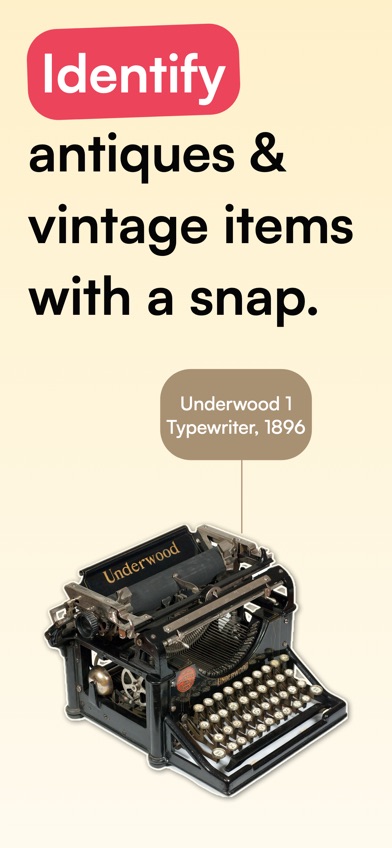
Curio is our first pick for someone who wants an identification and a value range from the same antique appraisal app. Its useful distinction is the checking step: Curio displays visually similar items from the web and lets you add a maker's mark, signature or pattern detail after the first result.
Those inputs help when two nearly identical vases have very different makers and prices. Curio also saves identified pieces, supports separate collections and can export a collection as a PDF. The US App Store listed 4.82 stars from 16,809 ratings, with the latest update dated September 10, 2026.
Curio ranks first because those research tools fit the valuation question better than a bare one-photo answer. AntiqSnap has almost twice as many ratings and supports Android, so it wins on reach. Curio's main irritation is price ambiguity: the App Store lists purchases from $4.99 to $49.99 without consistently identifying the billing period. Free-use limits are also unstated. Check the purchase screen before starting a large inventory.
- Visual matches let you inspect similar items.
- Added marks can refine the first result.
- Collections can be exported as a PDF.
- Android support is not confirmed.
- Subscription periods and free limits are unclear.
- Price
- Price checked October 2026: in-app purchases range from $4.99 to $49.99; check the listing for billing periods.
- Platforms
- iPhone and iPad; iOS 16.4 or later.
Pick Curio if you want to check a photo estimate against visual matches and visible maker details.

AntiqSnap
4.7 on the App Store (31,460 ratings)
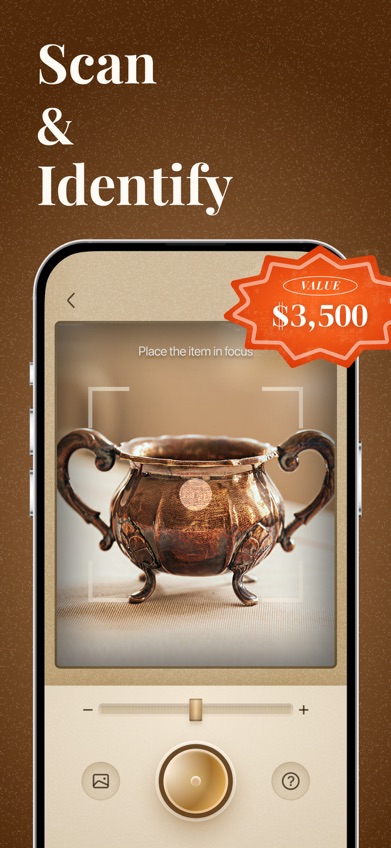
AntiqSnap identifies an item from a photo, estimates its market value and rarity, and saves the result to a collection. It also tracks an estimated total collection value. That is handy when sorting an inherited cabinet instead of researching one isolated plate.
AntiqSnap has the largest App Store audience in this group: 4.68 stars from 31,460 ratings. It was updated October 22, 2026, one day before our check, and supports nine languages. It is also one of the few choices here with confirmed Android availability. Curio remains first because Curio more clearly describes visual matches and user-added mark details.
Treat AntiqSnap's values as screening estimates. Available review evidence includes complaints about inflated prices, general identifications and reliance on a single view. The listing does not state how many scans are free. Purchases from $3.99 to $39.99 appear in the App Store, though most billing periods are not identified. That makes the annual cost hard to judge before the subscription screen appears.
- Confirmed support for both iOS and Android.
- Tracks saved finds and estimated collection value.
- Updated in October 2026.
- Free-scan limits and billing periods are unclear.
- One photo may miss marks, damage or construction details.
- Price
- Price checked October 2026: listed purchases run from $3.99 to $39.99; check the subscription screen.
- Platforms
- iPhone, iPad and Android; iOS 16 or later.
Pick AntiqSnap if you use Android or want a quick archive for many household finds.

Antique Identifier TIQ
4.7 on the App Store (9 ratings)
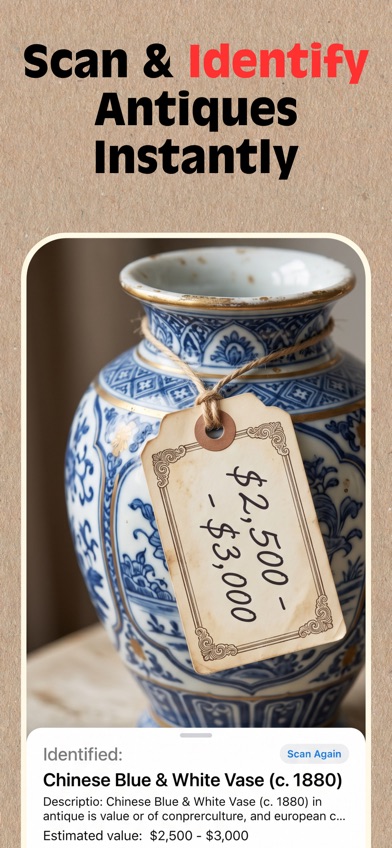
Antique Identifier TIQ is a photo-based antique value app that pairs a likely identity and rough value range with clues about maker marks, materials, construction and reproductions. That extra layer is useful when the real question is whether an estate-sale item deserves more research before you buy it.
TIQ also supplies era and origin hints, comparable examples and collection storage. It does not authenticate an object, and its guidance cannot replace physical inspection. The biggest evidence gap is age: TIQ launched June 18, 2026, and had 4.67 stars from nine US App Store ratings in October. Nine ratings tell us little about consistency across thousands of object types.
The pricing is unusually easy to understand. The yearly plan is $19.99; paying $4.99 every week for 52 weeks would cost $259.48. The annual plan is the sensible route for regular use. TIQ requires iOS 18, which cuts out older iPhones, and Android is not available. It ranks third because Curio has more store evidence and AntiqSnap supports more phones.
- Explains maker-mark and construction clues.
- The $19.99 annual price is plainly listed.
- Includes rough values and comparable examples.
- Only nine App Store ratings were available.
- Requires iOS 18 and has no Android version.
- Price
- Price checked October 2026: $4.99 weekly or $19.99 yearly.
- Platforms
- iPhone and iPad; iOS 18 or later.
Pick Antique Identifier TIQ if you want affordable photo research with authenticity clues on a recent iPhone.
WorthPoint
WorthPoint is the strongest choice here when valuation evidence is more important than instant object identification. Its main job is searching historical sold listings, which can answer a better question than what similar sellers are currently asking. Serious resellers and collectors may find that database more useful than an AI-generated range.
The trade-off is setup friction. You need enough information to search for the right maker, pattern, material or model, and picture identification is secondary. Old or superficially similar records can also mislead you when condition, dimensions and provenance differ. The mobile experience has more research steps than Curio or AntiqSnap.
WorthPoint works on the web, iPhone and Android. Available 2026 pricing sources place monthly access at about $29 to $30, though plan details should be checked before subscribing. That comes to roughly $348 to $360 over 12 months. It is hard to justify for one attic find, but easier to defend if you price inventory every week or need historical records unavailable in a quick scanner.
- Searches historical sold-price records.
- Works on phones and the web.
- Well suited to repeated resale research.
- Costs about $350 a year at the cited monthly price.
- Photo identification is not its main strength.
- Price
- Price checked October 2026: about $29 to $30 monthly; confirm current plans on the site.
- Platforms
- Web, iPhone and Android.
Pick WorthPoint if past sold prices will influence regular buying or selling decisions.

Antique Identifier Zophi
4.8 on the App Store (10,949 ratings)
Antique Identifier Zophi is a general photo scanner for antiques and collectibles. It returns an identification, estimated value and item history, then saves finds to a collection. Its strongest fit is less glamorous but useful: Zophi runs on iOS 15, while several rivals require iOS 16.4, 16.6 or 18.
The US App Store listed 4.79 stars from 10,949 ratings and an update dated October 7, 2026. That is a substantial rating base for an app released in June 2025. Its listing covers vases, coins, stamps and figurines, though it says little about sold-price records, visual comparison links or export tools.
Zophi lists weekly plans from $3.99 to $4.99 and annual plans from $19.99 to $34.99. Paying weekly for a full year would cost $207.48 to $259.48, so check the annual option before accepting a trial. The number of free scans is unknown, Android support is not confirmed, and the App Store reports one supported language. Choose it for device compatibility, not for the deepest valuation trail.
- Runs on iOS 15.
- Strong App Store rating count.
- Includes identification, values and saved finds.
- Comparable-sale sources are not described.
- Free limits and Android support are unknown.
- Price
- Price checked October 2026: $3.99 to $4.99 weekly or $19.99 to $34.99 yearly.
- Platforms
- iPhone and iPad; iOS 15 or later.
Pick Zophi if your older iPhone cannot install Curio, AntiqSnap or TIQ.

Relic
4.7 on the App Store (7,810 ratings)
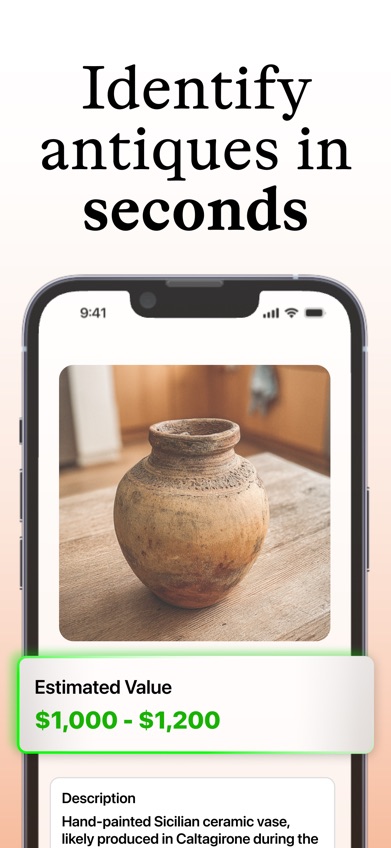
Relic turns a photo into an item record with a likely identity, origin, era, materials, condition notes and a value range. Its strongest tool is a locally stored, searchable catalog that can be filtered by keyword, value or period. That suits a reseller organizing stock on one device.
The listing also says Relic searches for similar items and previous sales. Those records can be useful, though any match still needs a check for size, condition and maker. Relic had 4.72 stars from 7,810 US App Store ratings and was updated October 7, 2026. It supports 12 languages.
Relic has no free AI identification, history, comparison or collection use; a subscription is required. The store lists $5.99 weekly and $39.99 yearly among several purchases, with other entries reaching $79.99. A full year at the weekly rate would cost $311.48. Relic ranks below Zophi because downloaders cannot meaningfully assess its core workflow for free, and the crowded purchase list makes plan selection harder than it needs to be.
- Searchable catalog is stored locally.
- Filters records by value, keyword or period.
- Includes similar items and past-sale research.
- Core AI tools require payment.
- The purchase list contains several unclear options.
- Price
- Price checked October 2026: $5.99 weekly or $39.99 yearly listed; other purchases reach $79.99.
- Platforms
- iPhone and iPad; iOS 16.4 or later.
Pick Relic if a local, searchable inventory is worth paying for before your first scan.

Collectibles.com
4.6 on the App Store (9,932 ratings)

Collectibles.com covers antiques alongside coins, trading cards, comics, watches, wine, sneakers and other collectibles. It combines image scanning and value lookups with collection profiles, market comparisons, price trends and community tools. That broad scope suits someone whose shelves contain more than traditional antiques.
The US App Store listed 4.63 stars from 9,932 ratings and an update dated September 1, 2026. The app has been available since 2020, longer than the other photo scanners covered here. Its community and profile tools are real strengths if you want to display a collection. They also add setup and social elements that a one-item antique search does not need.
Collectibles.com ranks last for this exact query because antiques are one category among many, while Curio, AntiqSnap and TIQ are built around antique identification. The listed plans include $8.99 monthly, $39.99 yearly and $99.99 lifetime, although other prices also appear. At $8.99 each month, a year costs $107.88. Free limits are unknown, Android availability is not confirmed, and the iOS listing has a 17+ age rating.
- Covers many collectible categories.
- Includes profiles, trends and community tools.
- A lifetime purchase is listed.
- Antiques are only part of its focus.
- Free limits and Android support are unknown.
- Price
- Price checked October 2026: $8.99 monthly, $39.99 yearly or $99.99 lifetime listed.
- Platforms
- iPhone and iPad; iOS 16.6 or later.
Pick Collectibles.com if you want one catalog for antiques, cards, coins, comics and other collections.
Curio vs AntiqSnap for antique values
Curio and AntiqSnap both identify antiques, estimate values and save results. Curio gives you more visible research steps; AntiqSnap works on more phones and has a much larger App Store rating count.
| Point | Curio | Rival |
|---|---|---|
| App Store rating | Curio had 4.82 stars from 16,809 ratings. | AntiqSnap had 4.68 stars from 31,460 ratings. |
| Estimate checking | Curio shows visual matches and accepts added mark details. | AntiqSnap supplies value and rarity estimates from a quick photo. |
| Collection tools | Curio saves collections and exports them as PDFs. | AntiqSnap tracks an estimated total collection value. |
| Platforms | Curio has confirmed iPhone and iPad support. | AntiqSnap has confirmed iPhone, iPad and Android support. |
| Latest update | Curio was updated September 10, 2026. | AntiqSnap was updated October 22, 2026. |
Curio wins for iPhone users who want to inspect similar images, add a maker mark and export records. Those steps make its first estimate easier to question, which is healthy when money is involved.
AntiqSnap wins on Android availability, rating volume and collection totals. Pick AntiqSnap if phone support or processing a large pile of household items outweighs Curio's extra research controls.
What to check before paying for an antique appraisal app
Where the value comes from
A dollar figure without evidence is decoration. Look for sold records, visual matches or comparable listings you can inspect. Sold prices usually tell you more than current asking prices, though condition and date still affect the comparison. WorthPoint is strongest for historical records; Curio is better for visual matching during initial identification. A broad AI range is fine for deciding what to research next.
Photos, marks and condition
A single front photo can miss the information that sets the price. Photograph the underside, signatures, labels, joints, damage and any repair work. Apps that accept added mark details have an advantage. Even then, a camera cannot inspect an internal mechanism or determine whether old-looking wear is genuine. A fuzzy backstamp photographed under a yellow ceiling light is an excellent recipe for confident nonsense.
The real annual cost
Weekly subscriptions are expensive when left running. TIQ costs $259.48 for 52 weekly payments but lists a $19.99 annual plan. Relic's $5.99 weekly rate reaches $311.48 over a year, compared with its listed $39.99 yearly plan. Check free-scan limits, trial end dates and cancellation instructions before uploading an entire collection. The cheapest plan is the one you remember to cancel.
Privacy and professional appraisal
Uploaded photos may reveal addresses, family documents or the contents of a private collection. Read the store's privacy label and data-safety section before scanning those items. For insurance, estate settlement, tax donation, authentication or a high-value sale, use a qualified appraiser or relevant auction specialist. An app estimate is research evidence; it is not a signed appraisal or a guaranteed selling price.
Frequently asked questions
What is the best antique value app?
Curio is the best antique value app for most iPhone users because it combines photo identification, value ranges, visual matches and collection exports. Android users should consider AntiqSnap.
Is there a free antique value app?
Most antique value apps are free to download, but listings often leave the free-scan limit unstated. Check the purchase screen before scanning a full collection.
Which antique app uses sold prices?
WorthPoint is the strongest pick for searching historical sold-price records. WorthPoint suits regular sellers who already know enough about an item to search accurately.
Can an antique appraisal app tell if an item is real?
No photo-based antique appraisal app can prove authenticity or reliably detect every reproduction. Valuable items need physical examination by a qualified specialist.
What is my antique worth?
Start with several clear photos, identify the maker and pattern, then compare recent sales of matching items in similar condition. An asking price or AI estimate alone cannot tell you what a buyer will pay.
Which app can identify maker's marks?
Curio lets you add maker-mark, signature and pattern details to refine a result. Curio also shows visual matches so you can inspect likely comparisons.
What antique value apps work on Android?
AntiqSnap and WorthPoint have confirmed Android availability. AntiqSnap is better for quick photo identification, while WorthPoint is better for historical price research.
Our recommendation
Choose Curio if you use an iPhone and want the best balance of photo identification, value estimates and evidence you can inspect. AntiqSnap is the better download for Android or rapid collection building, while WorthPoint is worth its higher yearly cost for sellers who regularly need historical sold prices. TIQ is a good lower-cost iPhone option when maker marks and authenticity clues are your main concern.
Antique Identifier TIQ is best for affordable authenticity clues
Antique Identifier TIQ is worth trying for its strongest tool: photo-based clues about maker marks, construction, era consistency and common signs of reproductions. That makes it useful for an iPhone owner screening flea-market finds or inherited objects before doing deeper research. The $19.99 annual plan is much easier to defend than its weekly rate. TIQ is new and has only nine App Store ratings, so use its result as a research lead, not authentication.