
Collection Apps Compared by Fees, Permissions, and Export
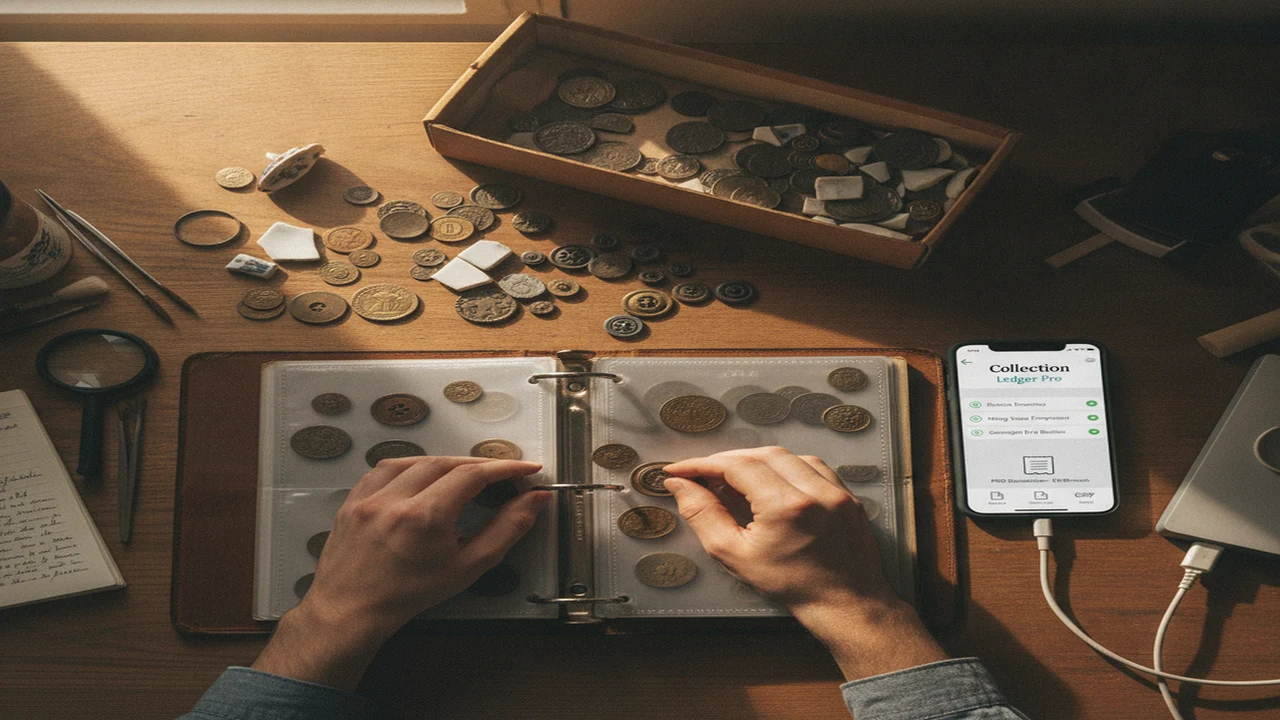
An app can identify one photographed vase and still be a poor place to store 300 collection records. The real buying decision begins after the first result: Can you correct the record, find it later, move it elsewhere, and stop paying without losing useful work?
That makes fees, permissions, record structure, and export more important than a polished estimate screen. A cautious buyer should enter a few objects first, confirm what the subscription covers, and make sure the resulting inventory remains useful outside the app.
Quick answer: Choose a collection app by checking recurring cost, photo permissions, editable fields, export format, and cancellation terms before entering a full binder or shoebox. Curio documents PDF collection export, while Relic, Antique Identifier By Picture, and AntiqSnap offer different identification and tracking features. Any identity or value estimate should be a research starting point, not a certified appraisal.
What does this mean?
Definition: A collection app creates digital records for physical objects, usually combining photos, identification suggestions, value ranges, notes, and collection tracking, with some apps also offering a portable export.
What should you compare before choosing a collection app?
Start with five decision points: subscription cost, requested permissions, editable record fields, export options, and cancellation or data-retention terms. These reveal whether an antique appraisal app is suitable for long-term cataloging or mainly designed for occasional photo searches.
Identifying one object is different from maintaining hundreds of records. A binder, cabinet, or shoebox collection needs consistent item names, storage locations, condition notes, searchable categories, and a way to correct uncertain suggestions. An identity or antique market value range is much less useful when the underlying record cannot be edited or exported.
Check whether the download is genuinely useful without payment, when a trial renews, and which features require a subscription. Our guide to antique apps worth paying for based on listed features covers that store-listing check in more detail.
- Cost: Separate a free download from free scans, saved records, exports, and ongoing updates.
- Permissions: Look for access that matches the photo and cataloging task.
- Fields: Confirm that identity, condition, dimensions, notes, and location are editable.
- Export: Check the format and which photos or fields it includes.
- Exit terms: Review renewal, cancellation, account deletion, and data-retention information.
Which app features matter for a binder or shoebox workflow?
A manageable workflow starts with several useful images, not one attractive front view. Photograph the front, back, maker marks, damage, and a ruler or another scale reference. Close-ups matter when trying to identify antique marks and hallmarks, identify maker signatures, or distinguish similar porcelain and ceramics.
Review the suggested identity before saving it. Useful editable fields include item type, maker, period, material, dimensions, condition, acquisition price, storage location, notes, and value range. Keep close-up mark photos with the main object image so later research does not depend on finding the object again.
For readers learning how specialist photo search differs from ordinary reverse image search, the Antique Identifier App explains the research process. Antique Identifier TIQ can be considered at that research stage, while the collection database still needs to be judged on its own fields and portability.
A repeatable photo routine also reduces missing information. See the guide to photographing a flea-market find and looking up sold listings for a focused capture-and-research process.
- Photograph the front, back, marks, damage, and a scale reference.
- Review the suggested category, maker, material, age, and value range.
- Correct uncertain or incomplete fields before saving the record.
- Label the item with a storage location or matching inventory number.
- Verify important claims with marks, dimensions, construction, and outside references.
- Export a few sample records in the available format.
- Back up the exported file and original photographs separately.
How do the main collection apps compare?
The table is a documentation-based buying snapshot checked August 6, 2026. Where the reviewed material did not provide an exact price, trial length, permission, or export format, the entry says to check the current listing rather than assuming the feature is unavailable.
WorthPoint and Google Lens can supplement this shortlist. WorthPoint is oriented toward historical sales research, while Google Lens can help locate visually similar objects and pages. Neither should automatically be considered a substitute for an editable collection manager.
Readers who mainly want to search antiques by photo may find that Antique Identifier TIQ and other research routes fit the immediate question better than paying for collection functions they will rarely use.
Which fees and subscription terms deserve the closest look?
A free download does not necessarily include free identifications, saved records, value updates, comparison results, or exports. Check each feature separately, along with whether the offer is a limited free tier, trial, weekly subscription, monthly subscription, annual plan, or one-time purchase.
Weekly billing can become costly over a long cataloging project, while a scan limit may make a low introductory price less useful for a large collection. Relic documents a subscription requirement for its AI identification and collection functions, but its current price and renewal terms should be confirmed at checkout. Apply the same current-listing check to Curio, Antique Identifier By Picture, and AntiqSnap.
Take screenshots of the checkout screen, renewal price, trial deadline, included limits, and cancellation route. The right value depends on collection size and whether the paid plan provides records and exports you can continue using, not on which app claims to be the best antique identifier app.
Which permissions should a collection app request?
Camera access has a clear purpose when an app takes new object photos. Photo-library access can also fit the task when importing existing images, but selected-photo or limited access is the more restrained choice when the phone offers it.
Location, contacts, microphone, and tracking permissions need a feature-based explanation. They may not be necessary for basic cataloging. Review the current store privacy label, developer privacy policy, cloud-storage terms, account-deletion process, and relevant controls in the phone's settings.
Object photos can accidentally show faces, documents, addresses, rooms, or valuable items nearby. Crop unnecessary background details and consider whether location metadata remains attached before uploading. Permission scope and retention practices may differ between platforms and app versions.
Why does export matter before you scan a whole collection?
Export determines whether your records remain useful beyond the original app. A PDF is readable and easy to share, while CSV or spreadsheet output is better for editing, sorting, filtering, and migration. Image export preserves pictures, cloud backup protects an account-based library, and a share-only summary may provide little reusable data.
Curio documents PDF collection export. That is useful for readable inventory reports, but PDF is not the same as editable CSV columns. Verify whether its reports include original photos, item IDs, notes, storage locations, and value history rather than assuming every saved field appears.
Export a few sample records before entering a full binder or shoebox if the app permits it. Screenshots are a weak fallback because they are difficult to search, sort, update, and migrate. Even major app ecosystems document report downloads and defined reporting controls, as shown in Google Play Console reporting documentation; collection-app buyers should look for similarly concrete export instructions.
Antique Identifier TIQ is better considered as a photo-search and research resource unless its current documentation supports the database, backup, and export functions required for a full collection.
How should you check an identification or value estimate?
Are antique identifier apps accurate? The honest answer is conditional. Results depend on photo quality, visible marks, category coverage, available comparison data, and whether a modern reproduction closely resembles an older object. Different angles or incomplete details can also lead to different suggestions.
An antique value checker generally provides a market range or a comparable-object estimate, not a certified appraisal. Verify the maker's marks, construction, dimensions, materials, condition, provenance, and relevant sold comparisons. Raw, restored, damaged, and professionally authenticated examples should not be blended without explanation.
Antique silver identification may require hallmarks and weight. Porcelain and ceramics can depend on foot rims, backstamps, and decoration methods. Antique furniture identification often requires joinery, hardware, wood, dimensions, and evidence of later alterations.
WorthPoint and Google Lens offer additional research routes, while Antique Identifier TIQ may be a starting point for antique history and context. If the question is how much is my antique worth for insurance, tax, an estate, authentication, or a high-value sale, seek a qualified human appraiser. Our explanation of why a photo estimate is not a formal appraisal outlines that boundary.
What are the limits of this comparison?
This comparison relies on public listings, product documentation, supplied review summaries, and subscription information checked August 6, 2026. No apps were installed or accuracy-tested for this article.
Prices, free tiers, trials, permissions, privacy labels, and export options can change by platform, region, and app version. An undocumented feature or permission remains unknown rather than proven absent.
Photo identities and value ranges are research leads, not guarantees of authenticity, selling price, or certified appraisal value. User-review concerns can flag issues worth investigating, but anecdotal reports do not establish a universal error or failure rate.
Which collection app is worth considering?
Curio is worth considering when documented PDF collection reporting is the priority, provided a readable report is sufficient and you do not require editable CSV data. Relic fits readers interested in material identification, country-of-origin estimates, and provenance notes who accept its subscription requirement.
Antique Identifier By Picture offers material and age details, a collection manager, value estimates, and background removal, but current reviews and advertising or billing terms deserve attention. AntiqSnap offers total collection value tracking and collector articles, with review concerns about material results and reproductions worth checking.
Readers focused mainly on photo-based research can consider Antique Identifier TIQ alongside WorthPoint, Google Lens, sold listings, and specialist references instead of paying for unused collection features. Enter only a few records until the cost, permissions, editability, and export meet your needs.
Comparison
| App | Documented collection features | Fee or subscription issue | Export | Permissions to verify | Main trade-off |
|---|---|---|---|---|---|
| Antique Identifier - Relic | Material identification, country-of-origin estimate, and history or provenance notes | Subscription required for AI identification, history, comparisons, and collection functions; check current price | Check current listing | Camera, photo access, privacy label, and any cloud-account permissions | Detailed record suggestions come with a subscription requirement |
| Curio - Antique Identifier | Photo antique identification, background information, comparable objects, and value ranges | Check current listing for free limits, trial, and renewal terms | PDF collection export documented | Camera, photo access, account storage, and privacy label | PDF is readable but may not provide editable spreadsheet columns; estimates are not certified appraisals |
| Antique Identifier By Picture | Material and age details, collection manager, quick value estimate, and background object removal | Check current listing for advertisements, limits, and paid features | Check current listing | Camera, selected-photo access, cloud storage, and privacy label | Reviews mention advertising, changing scan results, and occasional maker or region errors |
| AntiqSnap: Antique Identifier | Identification guidance, total collection value, condition suggestions, and collector learning articles | Check current listing for trial, scan limits, and renewal terms | Check current listing | Camera, selected-photo access, account storage, and privacy label | Reviews raise concerns about some material results and distinguishing reproductions |
| WorthPoint | Historical sales and object research rather than a simple photo-first collection workflow | Check current service terms | Check current listing | Account, uploaded-image, and privacy terms where applicable | Useful as supplementary price research, not automatically a structured collection manager |
| Google Lens | Visual search for similar objects, websites, and possible identifying clues | Check current platform terms | Unknown for structured collection export | Camera, selected-photo access, account settings, and activity controls | Research tool rather than a dedicated antique collection database |
Limitations
Frequently Asked Questions
Are antique identifier apps accurate?
Accuracy varies with image quality, visible marks, materials, category coverage, and the app's comparison data. Reproductions and visually similar objects can produce uncertain results, so verify important findings with construction details, provenance, sold comparisons, and specialist references.
Can an app appraise antiques by picture for free?
Possibly, but a free download may not include free scans, saved records, repeated searches, or exports. Check whether the offer is a limited free tier or a trial that renews into a paid subscription.
Does Antique Identifier TIQ replace a professional antique appraiser?
No. Antique Identifier TIQ can support preliminary research, but insurance, estate, tax, authentication, and high-value sale decisions may require a qualified appraiser who can inspect the object and issue appropriate documentation.
What photos should I take to identify antique marks and hallmarks?
Take the front, back, base, underside, hardware, damage, and close-ups of every mark or signature. Add a ruler for scale, use even light, keep text sharp, and avoid filters that change color or surface detail.
Can Antique Identifier TIQ save an antique collection?
Check its current listing for saved-record limits, account requirements, cloud backup, deletion controls, and export formats. Do not assume that a photo-search feature includes a portable collection database.
Is PDF or CSV better for exporting a collection?
PDF is better for readable reports and sharing. CSV is better for editable, sortable records and migration. Neither format necessarily includes original photos, so confirm whether images require a separate download.
What permissions does an antique identifier by picture need?
Camera access and selected-photo access fit the core task. Location, contacts, microphone, or tracking requests need a clear feature-based reason. Review phone settings, the store privacy label, the privacy policy, and account-deletion controls.
How can I cancel an antique appraisal app subscription?
Use the subscription management page associated with the store or payment account, then confirm that renewal has stopped. Also review the developer's account-deletion and data-retention options, because cancelling payment may not delete stored photos or records.