
Why a Photo Estimate Is Not a Formal Appraisal
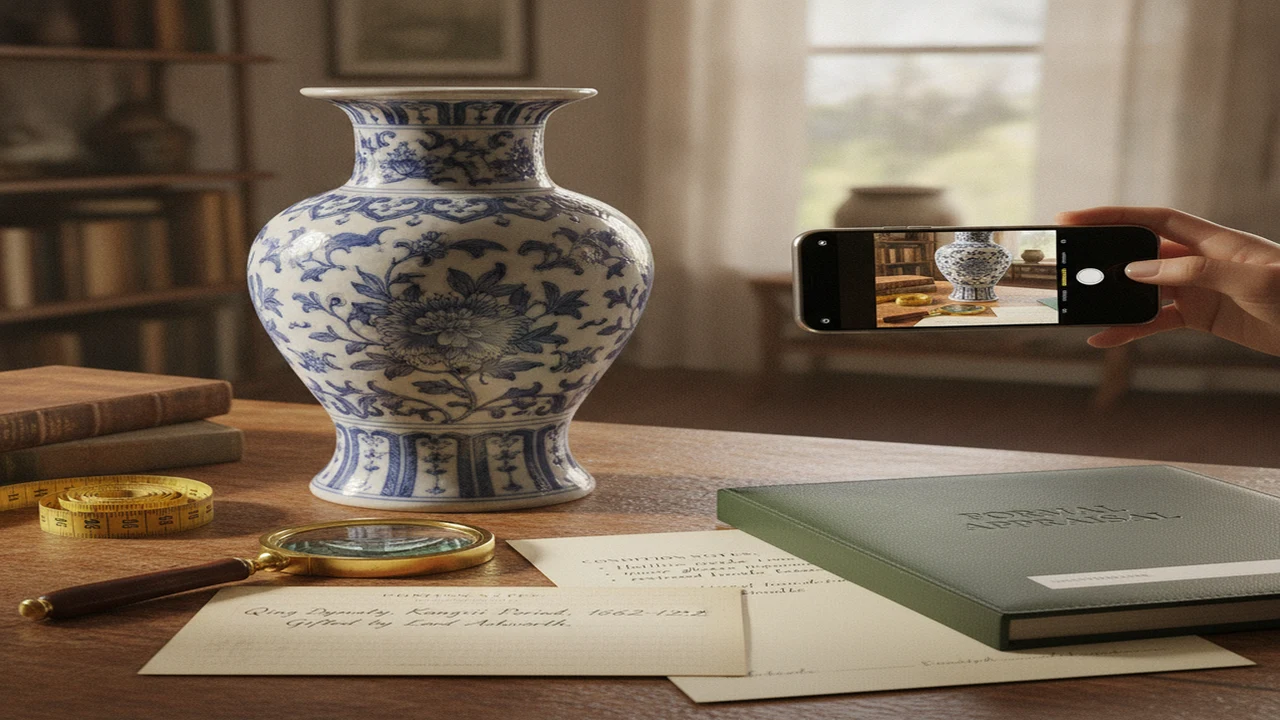
Point a phone at an inherited vase or brooch and an app may return a maker, period, material, or tempting price range within seconds. That can answer the first question, “What might this be?” It cannot settle authenticity, hidden condition, ownership history, or the kind of value needed for a specific financial purpose.
The useful distinction is not app versus expert in every situation. It is low-stakes sorting versus a decision where another party will rely on the result. A photo estimate can help organize research, while a formal appraisal is built to support a defined assignment.
Quick answer: A photo estimate can suggest an item’s identity and possible market range, but it lacks the inspection, documented method, value definition, credentials, and signed report expected from a formal appraisal. Use photo tools to sort a binder, cabinet, or shoebox collection. For insurance, estates, taxes, donations, or disputes, ask the relevant organization what appraisal standard and qualifications it requires.
What does this mean?
Definition: A photo estimate is a preliminary identification or value range generated from visible details and available comparison data, while a formal appraisal is a documented opinion of value prepared for a stated purpose, date, market, and value standard by a suitably qualified professional.
What does a photo estimate actually tell you?
A photo tool may propose an object type, maker, era, style, material, and visible condition clues. It may also produce an antique market value range based on visually similar records. These outputs are useful leads, especially when the alternative is starting with no name or category at all.
People trying to identify antiques by photo should read the result as a research prompt rather than a certificate of authenticity. An antique identifier by picture cannot guarantee that the proposed model, production date, material, or price applies to the photographed object.
Consider a shoebox of inherited costume jewelry. A photo tool might separate likely silver pieces, plated items, brooches, and modern reproductions into research groups. The owner can then photograph marks and investigate the most promising pieces instead of paying for professional attention on every item.
The same approach works for ceramics, furniture photographs, and small collectibles. A proposed identity can supply useful search terms and antique history and context, but the displayed range is not a guaranteed selling price.
What makes a formal appraisal different?
A formal appraisal is prepared for a stated purpose and intended user. It identifies the effective date, defines the type of value being developed, describes the relevant market, records the item, explains the research method, and discloses assumptions and limiting conditions. The completed work ordinarily includes a signed conclusion from the appraiser.
The value definition matters. Fair market value, replacement value, liquidation value, and other defined measures can answer different questions. The appropriate figure for insurance coverage may be unlike the amount an owner could reasonably receive through a local sale.
The inspection may involve measurements, construction details, maker marks, material analysis, provenance records, repair history, and condition that a front-facing image cannot show. Jewelry may require examination of metal, gemstones, treatments, settings, and replacement components. Furniture can require inspection of joinery, surfaces, hardware, and alterations.
Qualifications should match the category and assignment. An antique jewelry identifier may generate useful leads, but it does not replace relevant jewelry, gemstone, or appraisal expertise. The Appraisal Institute’s Guide Notes illustrate why professional appraisal work depends on defined standards and assignment conditions rather than a quick visual match.
There is no single report rule accepted by every insurer, court, tax authority, or receiving organization. The party requesting the appraisal should identify the format, scope, and professional qualifications it will accept.
Why can a single photograph produce the wrong value?
Photographs hide information. They may omit cracks, restoration, replaced parts, altered surfaces, odors, movement, weight, scale, material composition, and damage outside the frame. A case or mount can conceal construction details, while reflected light can make a surface look cleaner or more uniform than it is.
Reproductions, later editions, workshop pieces, and genuine period objects can share visible designs. Two objects that look alike on a phone screen may differ in material, manufacturing method, maker, date, condition, or provenance. Those differences can substantially change buyer interest.
For porcelain and ceramics, a blurry base mark can point to the wrong factory or production period. A genuine vase with professional restoration may also look similar to an undamaged example until the repaired area is examined under suitable light.
With jewelry, a photograph may not distinguish solid precious metal from plating or identify a gemstone reliably. With furniture, the front view cannot reveal replacement drawer sides, modern screws, refinishing, or altered legs.
Attempts to identify antique marks and hallmarks or identify maker signatures are especially vulnerable to partial signatures, glare, wear, and decorative marks that resemble manufacturer symbols. Asking “how much is my antique worth?” therefore requires more than finding the highest visually similar online listing.
Why are asking prices and sold prices not the same thing?
An active asking price shows what a seller hopes to receive. It does not show that a buyer accepted that amount. An unsold listing may remain online because its price is too high, its description is weak, or demand is limited.
Completed sales and auction results are usually better comparison points, but they still need interpretation. Venue, buyer demand, seller reputation, location, season, condition, rarity, shipping cost, auction premiums, commissions, and whether an object was sold alone or in a mixed lot can all affect the result.
WorthPoint may help researchers locate historical comparisons. A database result still needs to be checked for material, size, condition, date, maker, and selling venue. It does not become a formal appraisal simply because the record contains a completed price.
The chosen value standard also changes the answer. Replacement value for an insurance assignment can differ from a likely resale amount or fair market value. A sensible antique value checker should explain what its range represents instead of presenting one number as suitable for every purpose.
Avoid anchoring on the highest attractive listing. A small group of close completed comparisons, adjusted for visible differences and selling costs, is more informative than one optimistic asking price.
When is a photo estimate useful enough?
Photo estimates are worth using for collection triage. They can help sort a binder, cabinet, storage bin, or shoebox into known items, uncertain items, likely reproductions, and pieces that deserve deeper research.
Start by photographing the front, back, sides, base, marks, fasteners, and damaged areas. Record dimensions separately because a photograph rarely communicates scale accurately. Our guide to photographing a find and checking sold listings covers a focused version of that workflow.
Google Lens can be useful when you want to search antiques by photo and collect possible names or visually similar examples. Verify the proposed identity through maker references, museum records, specialist books, auction archives, and several close comparison sales.
A better photograph improves the research input, but it does not transform an automated estimate into an appraisal. Keep uncertain and potentially valuable pieces in a separate queue for specialist review.
- Photograph every side, the base, hardware, labels, signatures, and damaged areas.
- Measure height, width, depth, diameter, and weight when relevant.
- Record materials, moving parts, inscriptions, labels, odors, and visible wear.
- Inspect for cracks, repairs, replacement pieces, refinishing, and alterations.
- Research proposed makers, marks, periods, and object categories through multiple sources.
- Compare completed sales with similar dimensions, materials, condition, and features.
- Prioritize uncertain pieces, suspected rarities, and objects with potentially significant value.
- Consult a suitably qualified professional when another party will rely on the result.
When should you pay for a formal appraisal?
Professional documentation may be appropriate for insurance scheduling, estate administration, charitable donations, equitable distribution, lending, litigation, suspected high value, or a dispute about authenticity or condition. These situations involve more than personal curiosity because an insurer, accountant, attorney, court, lender, buyer, or receiving organization may rely on the conclusion.
Ask that organization what report format, value definition, inspection method, and appraiser qualifications it accepts before hiring anyone. Requirements vary, and paying for the wrong type of report can mean paying again.
An auction house may provide an estimate for a possible sale. That range can help a consignor discuss expectations, but it may not satisfy an insurer, court, tax authority, or charitable organization requesting a formal appraisal.
When interviewing an appraiser, ask about category expertise, fees, scope, inspection method, report contents, conflicts of interest, and delivery date. Confirm whether laboratory work or an additional specialist might be needed.
An app can still support preparation by organizing photographs and notes. If you are also choosing an antique identification app based on listed features, keep that purchase separate from the decision to commission professional documentation.
What should you check before installing an antique value app?
Start with cost and privacy. Review camera and photo-library access, account requirements, data retention, deletion controls, and the developer’s privacy disclosures. Avoid uploading documents, inventory labels, personal correspondence, signatures, or serial information that is not needed for identification.
Check the subscription price, trial conversion date, renewal period, cancellation steps, and which functions remain available on the free tier. A one-time identification may not justify a recurring plan, while a searchable collection record could be useful for someone cataloging hundreds of objects.
Antique Identifier - Relic is an example of a listing centered on photo identification, a USD value estimate, and a searchable antique catalog. According to the documented summary reviewed for this article, its AI identification, history, comparison, and collection functions require a subscription.
Read estimate wording carefully. An AI antique price guide should distinguish a visual research range from work performed by an accredited antique appraiser. Claims that an app can appraise antiques by picture deserve particular scrutiny when the listing does not explain the value definition, evidence, inspection limits, or report credentials.
Before spending hours saving an antique collection, check whether records can be exported, downloaded, or backed up in a usable format. Our comparison of fees, permissions, and export options explains why collection portability matters when a subscription ends.
What are the limits of this explanation?
This is a documentation-based consumer guide, not a hands-on accuracy test, appraisal, authenticity opinion, or substitute for advice from a category-specific professional. It explains how to separate preliminary photo research from higher-stakes appraisal work.
- No hands-on app test or accuracy rate was available for this article.
- A photograph can omit materials, scale, repairs, construction, provenance, and hidden condition issues.
- App features, subscription terms, permissions, and privacy practices can change after the article date.
- Public listings may not show every feature, permission, restriction, or subscription change.
- Formal requirements differ by purpose, organization, object category, jurisdiction, and location.
Comparison
| Need | Photo estimate may be enough | Formal appraisal may be needed | What to save |
|---|---|---|---|
| Personal collection catalog | Usually useful for labels, categories, and research queues | Only if significant value or another party will rely on it | All-side photos, dimensions, marks, damage, and notes |
| Curiosity about identity or era | Useful as a starting point | If authenticity or precise attribution matters | Suggested identity and sources used to verify it |
| Preliminary resale research | Useful for finding close completed comparisons | For suspected high value or disputed authenticity | Sold records, fees, condition differences, and dates |
| Insurance coverage | Not a substitute for required documentation | Often, depending on the insurer and item | Policy requirements, report, photographs, and receipts |
| Estate or tax documentation | Useful only for initial sorting | Commonly required when an authority or adviser requests it | Provenance, ownership records, report, and effective date |
| Charitable donation | Useful for cataloging the proposed donation | May be required under the receiving organization’s rules | Organization instructions, item records, and signed report |
| Authenticity or condition dispute | Can help frame questions but not settle the dispute | Usually appropriate when money or liability depends on the answer | Detailed images, correspondence, receipts, and expert findings |
Limitations
Frequently Asked Questions
Can a photograph tell me how much an antique is worth?
A photograph can support a preliminary range by helping identify visually similar objects and comparison sales. It cannot settle value when materials, hidden condition, repairs, provenance, market choice, and the required definition of value remain unknown.
Is an AI antique identifier the same as an antique appraiser?
No. An AI antique identifier can suggest an identity, period, style, or price range from visible information. An antique appraiser develops an opinion for a defined purpose using relevant inspection, research, qualifications, and documentation.
Can Antique Identifier TIQ provide a formal appraisal?
Antique Identifier TIQ may be considered as a photo-identification or collection-triage aid. Do not assume its result is a formal appraisal unless current documentation explicitly confirms the accepted credentials, inspection process, value definition, and signed report required by the organization using it.
What photos should I take before researching an antique?
Take clear views of every side, the base, maker marks, signatures, labels, hardware, joints, and damaged areas. Record dimensions and save provenance notes, receipts, or family history separately. Better documentation improves research without guaranteeing a correct identification.
Can Antique Identifier TIQ help organize an inherited collection?
Antique Identifier TIQ may help with an initial photo-identification and sorting pass. Keep your own backup of images, dimensions, damage notes, and family history, and check whether saved records can be exported before building a large catalog.
Is Google Lens enough to identify antique marks and hallmarks?
Google Lens can surface visually similar marks and possible maker names, but those matches require verification. Glare, wear, partial signatures, and marks reused across periods can produce misleading results.
Do I need an appraisal before selling an antique?
Not for every ordinary sale. Preliminary research and completed-price comparisons may be enough for a low-stakes listing. Consider professional help when value may be significant, authenticity is uncertain, condition is disputed, or a buyer or other organization requests documentation.