
Photograph a Flea Market Find and Look Up Sold Listings
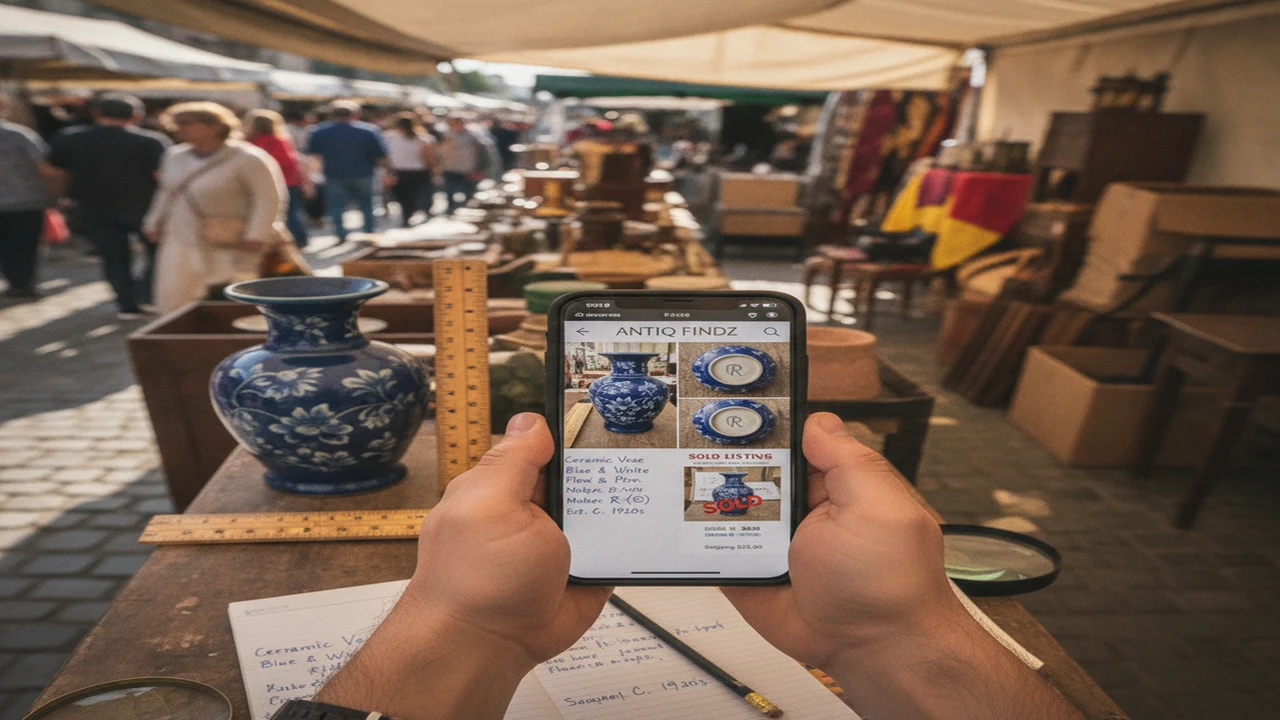
A promising flea market find can become difficult to research once you leave the stall. The seller's description may be vague, the maker mark may be underneath, and the asking price may have little connection to recent sales.
A better approach is to preserve the clues first, build a careful identification query, and then look for several close sold records. The phone is useful for gathering and organizing evidence, but the final judgment still depends on condition, construction, marks, and the quality of the comparable listings.
Quick answer: Take clear photos of the whole object, maker marks, materials, damage, and scale. Turn those clues into specific search terms, then filter marketplace results to sold or completed listings. Compare several genuinely similar items while accounting for condition, size, shipping, and hidden offer prices. Photo identification tools can narrow the search, but they cannot replace sold-listing research or a qualified appraisal.
What does this mean?
Definition: A sold listing is a marketplace record showing that an item sold or otherwise completed, which can provide a more useful value reference than an active asking price, although accepted offers, bundled sales, fees, and item differences may obscure the final amount.
What should you do before photographing a flea market find?
Handle the object as though an overlooked label, loose component, or old surface could matter. Ask the seller before opening drawers, turning mechanisms, removing covers, or lifting a framed piece from the wall.
Record the stall price and any story the seller gives you about the object's origin. Keep that story labeled as a seller claim unless receipts, family records, exhibition labels, or other documents support it.
Measure height, width, and depth. Record weight when practical, along with apparent materials, construction, moving parts, odors, repairs, and missing pieces. These details will later help separate a close match from a superficial lookalike.
Avoid polishing metal, washing paper labels, applying oil, or removing an item from its frame. Cleaning can erase patina, damage fragile finishes, blur ink, or remove manufacturing clues. It can also reduce value.
- Ask before moving, opening, or operating anything.
- Write down the price and unverified seller story.
- Check for loose, sharp, leaking, or unstable parts.
- Measure the object without forcing components.
- Leave cleaning and disassembly until the object is understood.
How do you take photos that reveal useful identification clues?
Use indirect daylight or even shade when possible. Place the item against a plain background that contrasts with its color, steady the phone, select the highest available camera resolution, and move physically closer instead of using digital zoom.
Photograph reflective metal, glass, and glazed ceramics at a slight angle. This reduces glare while keeping hallmarks and surface details visible. Check every image before leaving the stall because reflections can conceal a signature even when the photo initially looks sharp.
Include the front, back, underside, sides, interior, joints, fasteners, labels, hallmarks, maker signatures, serial numbers, decorative patterns, and damaged areas. A ruler can show scale, but do not cover a mark or scratch the object.
Crop out faces, payment cards, addresses, vehicle plates, receipts, and unrelated documents. If location details are sensitive, review the phone's location-metadata setting before sharing or uploading the image. Even a sharp photograph has limits, as our guide to why a photo estimate differs from a formal appraisal explains.
- Prepare: Choose stable support, even light, and a plain contrasting background.
- Photograph: Take a full-object image from the front, back, underside, and sides.
- Capture: Move closer for marks, labels, signatures, joints, fasteners, and patterns.
- Measure: Add dimensions and one scale photo without resting a hard tool on a delicate surface.
- Record: Photograph chips, cracks, wear, repairs, replaced parts, and missing components.
How can you turn the photos into useful search terms?
Start with what is visible, not what the seller called the object. List the object type, material, shape, decorative style, probable use, mark, country name, date code, dimensions, and condition. If a mark is partly readable, search both the visible letters and a description of its shape.
You can search antiques by photo with Google Lens, an antique identifier app, or both. Use the visual result to suggest a category, then verify it through text searches. Curio - Antique Identifier documents photo antique identification, an estimated antique value range, and visually similar objects. Those results are research leads rather than certified appraisals.
Antique Identifier TIQ can also serve as a starting aid. Its Identify Antiques guide goes deeper into photo value research and sold comps, but a suggested match should still be checked against marks, measurements, and construction.
Build the query from specific parts. For example, use “brass table object star hallmark 18 cm” rather than “rare antique brass.” Add or remove one clue at a time. Visually similar objects can come from different makers, periods, or manufacturing methods, and a modern reproduction may copy an older pattern.
How do you find sold listings instead of asking prices?
Search a broad phrase first. Open the marketplace filters, select sold or completed results where available, and then narrow the results by maker, material, dimensions, pattern, and condition. eBay's completed-listing guidance explains its documented search route.
Current listings show what sellers hope to receive. Sold records usually provide better market evidence, but you need to open each result rather than trusting its thumbnail. Check the description, dimensions, condition notes, accessories, sale date, seller location, and shipping terms.
Crossed-out prices and best-offer labels can hide the accepted amount. Bundled lots make it difficult to assign a price to one piece. Auctions with few bids, local-pickup sales, and unusually high shipping charges can also distort the apparent value.
Marketplace scale explains why filtering matters. eBay's Q2 2024 financial results reported more than 134 million active buyers globally, while eBay corporate reporting in 2024 cited more than 1.2 billion live listings. Approximately 73% of eBay gross merchandise volume came from mobile devices in 2024, according to eBay investor materials. Those figures indicate a large pool of records, not that every record is an appropriate comp.
Antique Identifier TIQ can help organize the early identification and value-research steps, but the record you rely on should come from closely matched listings. Use the table below to keep the comparison consistent.
How do you decide whether two items are truly comparable?
Use a three-level hierarchy. A near match shares the category, maker or workshop, mark format, material, construction, dimensions, pattern, completeness, and broadly similar condition. A useful partial match differs in one or two explainable areas. A visual lookalike resembles the object but lacks enough matching evidence and should be excluded.
Adjust in plain language rather than forcing a formula. A complete set may sell differently from one loose piece. Restored furniture can have a different audience from furniture retaining an old finish. A bulky object sold by local pickup may produce a lower price than a small item that is inexpensive to ship.
Antique furniture identification depends on joinery, hardware, wood, finish, and restoration. Porcelain and ceramics identification depends heavily on body material, glaze, foot construction, decoration, and marks. For antique jewelry identification, hallmarks, construction, metal testing, stones, and replaced components matter more than a similar outline in a photograph.
Use several recent and credible matches when the market provides them. Report a range, not a single precise number, and widen that range when the matches are old, sparse, or inconsistent.
What should you record for a binder or shoebox workflow?
A paper binder works well when you want a physical record beside stored objects. Give every item a number and record a thumbnail, measurements, marks, purchase place, purchase price, condition, suspected identity, comp URLs or listing IDs, sold dates, displayed prices, shipping, and confidence notes.
For a shoebox or storage-bin workflow, place a numbered tag with the item or its container and keep the full research record elsewhere. Do not attach an adhesive label directly to an antique because residue and removal can damage a surface.
For a digital collection, use consistent filenames such as “FM-026-front” and “FM-026-mark.” Preserve the original photos, keep a backup, and export records when the app permits it. Separate seller claims from findings supported by marks, documents, or sold listings.
Curio documents account collection sync and PDF collection export, which may suit readers who want records shared across devices. Antique Identifier TIQ is another possible digital research aid, but independent filenames and backups reduce the cost of switching apps later.
Our guide to collection apps, fees, permissions, and export options covers the trade-offs involved in keeping a searchable catalog. Readers considering a paid organizer can also review which antique app features may justify paying.
Which permissions and subscription terms should you check?
Read the current store listing and privacy disclosure before uploading collection photos. Check the requested scope of photo-library and camera access, account requirements, location collection, analytics, advertising identifiers, cloud processing, deletion controls, and whether data is linked to your identity.
Choose limited or selected-photo access when your phone offers it. Upload cropped copies rather than granting an app access to an entire library, particularly if your camera roll includes family images, documents, or location-sensitive photos.
Camera access or selected-photo access has an obvious purpose in an identification tool. Precise location or broad contact access deserves more scrutiny unless the listing explains a feature that needs it.
For a subscription, check the trial length, renewal price, billing period, cancellation route, scan limits, identification limits, export restrictions, and what happens to saved collections after cancellation. For Antique Identifier TIQ, confirm these details in the live listing rather than assuming terms or permissions that are not documented.
The right spending decision depends on frequency. An occasional market visitor may need only visual search and marketplace filters, while someone managing hundreds of finds may place more value on organization and export.
Comparison
| Comp field | What to record | Why it matters | Reason to exclude |
|---|---|---|---|
| Object identity | Category, form, likely use, and title wording | Confirms that the listing describes the same type of object | Different function or only a superficial visual resemblance |
| Maker or mark | Name, symbol, wording, placement, and mark format | Maker and mark variations can affect identification and price | Conflicting mark or attribution based only on a seller claim |
| Material and construction | Wood, metal, ceramic body, glass, fasteners, joints, and finish | Similar shapes made differently may come from different periods | Material or manufacturing method does not match |
| Dimensions | Height, width, depth, weight, and scale where available | Size can substantially change demand, rarity, and shipping | Large unexplained size difference |
| Condition and repairs | Wear, chips, cracks, replaced parts, refinishing, and restoration | Condition can explain price differences between close matches | Condition is undisclosed or much better or worse |
| Completeness | Lids, stands, cases, matching pieces, hardware, and accessories | A set or complete object may sell differently from one component | Listing is a lot or incomplete item that cannot be separated |
| Sold date | Date shown by the marketplace | Recent evidence is generally more relevant to current demand | Result is too old for a changing or thin market |
| Displayed sold price | Price, currency, auction or fixed-price format, and offer label | Forms the starting point for the observed range | Accepted offer, bundle, refund, or adjustment obscures the amount |
| Shipping or local pickup | Shipping charge, included shipping, or pickup requirement | Delivery cost can affect both buyer demand and effective price | Terms differ too much from the other comps |
| Listing ID or saved reference | Listing number, screenshot, URL, and short notes | Makes the research traceable if the result later disappears | No retrievable details or supporting description |
Limitations
Photo tools can suggest categories and visually similar objects, but they cannot confirm age, maker, material, or authenticity from appearance alone. Images may miss scale, weight, internal construction, repairs, replaced parts, material composition, and subtle antique authenticity clues.
A displayed sold price may differ from what the buyer paid when a best offer, bundle, refund, or private adjustment was involved. Sparse or old records may reflect rarity, weak demand, seasonal timing, regional interest, shipping, seller reputation, or inconsistent listing titles rather than a stable antique market value range. Condition, restoration, provenance, and sale venue can also make similar-looking objects poor comps.
Stop relying on photos alone when substantial money, authentication, insurance, estate or tax reporting, precious metals, gemstones, signed art, rare ceramics, culturally sensitive objects, hazardous materials, or disputed provenance are involved. An antique appraisal app can organize research, but it is not automatically a credentialed antique appraiser. Hand the photographs and comp record to an appropriate specialist for physical inspection.
Frequently Asked Questions
Are sold listings more reliable than active asking prices?
Usually, because they reflect completed transactions rather than seller hopes. They still need checks for accepted offers, shipping, condition, bundles, and whether the sold item is genuinely comparable.
Can Antique Identifier TIQ tell me exactly what an item is worth?
Antique Identifier TIQ may help suggest an identity and organize comp research, but it should not be expected to provide an exact price, certified appraisal, or authenticity decision. Market value depends on the item and the quality of the sold evidence.
What photos should I upload to an antique identifier app?
Include the whole object, front and back views, underside, sides, marks, labels, signatures, dimensions, construction details, and damage. Crop faces, addresses, payment information, and unrelated documents before uploading.
Can I use Antique Identifier TIQ without sharing my entire photo library?
Check the current permission prompt for Antique Identifier TIQ and choose limited or selected-photo access if your phone and the app support it. Do not assume a particular permission setup from an older listing or screenshot.
How many sold listings do I need before estimating a value range?
There is no reliable fixed minimum. Use several recent close matches where available. If only a few inconsistent records exist, report a wider range and label it as lower confidence.
Why do two similar antiques sell for very different prices?
Maker, age, size, construction, restoration, completeness, provenance, venue, timing, seller reputation, and shipping can all change the result. A similar shape or pattern does not make two objects equivalent.
When is a professional appraisal worth paying for?
Seek a qualified specialist when substantial value, insurance, tax, estate work, authentication, precious materials, safety, culturally sensitive material, or disputed provenance is involved. A photo app and a credentialed appraiser perform different jobs.